
CARDINAL RANJITH: CAN A 2018 CHANGE IN CATHOLIC DEATH PENALTY ERASE CENTURIES OF PAPAL ORDERS, PERSECUTION AND EXECUTIONS?

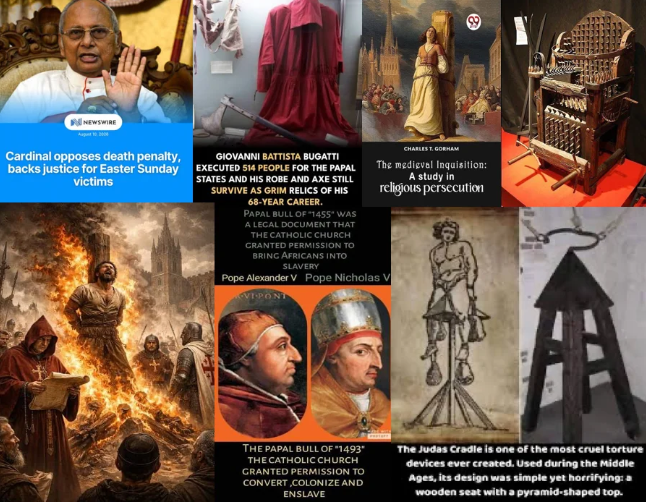 A historical record cannot be rewritten because it does not fit the new narrative.
Cardinal Malcolm Ranjith, Archbishop of Colombo, has stated that the death penalty is not compatible with the Catholic position. The Catholic Church’s present position on the death penalty is indeed clear: following the revision of Catechism paragraph 2267 approved by Pope Francis in 2018, the Church teaches that “the death penalty is inadmissible” and works for its abolition worldwide. But there is a fundamental historical question that cannot be avoided: Does a change in Catholic teaching in 2018 erase what the Popes and Church authorities ordered, authorised or instituted for centuries since 1199 before 2018? No.
The Catholic Church today rejects the death penalty.
BUT
The Catholic Church historically accepted capital punishment and, through papal and ecclesiastical authority, participated in systems that resulted in executions.
A later change in doctrine does not erase the historical record of over 800 years of Papal authorized executions & persecutions.
THE HISTORICAL RECORD
1184 — Pope Lucius III
Papal Bull: Ad abolendam
Date: 4 November 1184
Target: Heretics and those supporting heresy
At the Council of Verona, Pope Lucius III and Emperor Frederick Barbarossa established a system for identifying and punishing heresy.
The Church & secular authorities cooperated to deal with condemned heresy.
This transformed a religious denouncement to an organized legal system sanctioned by the Church.
Fact: the Church identified, condemned and sanctioned heresy; secular authorities were then required to enforce the prescribed penalties.
1199 — HERESY EQUATED WITH TREASON – Pope Innocent III
Decretal: Vergentis in senium
Date: 25 March 1199
Heresy was regarded as a crime against the state/treason making a religious error into a public crime. This resulted in people being burned to death.
1184 — identify and punish heresy
↓
1199 — heresy conceptualised as a crime comparable to treason
↓
1215 — secular rulers explicitly required to suppress it
1209 — THE ALBIGENSIAN CRUSADE – Pope Innocent III
Beginning: 1209
Target: Cathars/Albigensians and those supporting them in southern France.
The Pope called for a crusade against Cathars & their supporters. Crusade was another term for “executing every Cathar”
The crusade permitted armed violence and mass killing against those designated as enemies of the faith.
The campaign produced extremely large-scale killing, including the infamous capture and massacre at Béziers in July 1209.
The Pope authorized the military campaign resulting in large-scale killings.
1215 — FOURTH LATERAN COUNCIL – Pope Innocent III
Fourth Lateran Council
Date: November 1215
Canon 3 — On Heretics
This Papal order required convicted heretics to be handed to secular rulers to be punished.
The Papal order required secular rulers to “exterminate” heresy within their territories & to confiscate their property while the Papal Order imposed penalties on rulers who failed to suppress heresy.
The Canon even offered crusading privileges to those who took up arms for the “extermination of the heretics”.
The clergy did not carry out the executions but they ordered them after the Church handed over the convicted to secular authorities.
The process:
Church authority identified and condemned the heretic
↓
the condemned person was handed to secular authority
↓
the secular authority imposed the prescribed punishment
1231 — GREGORY IX AND THE INQUISITION – Pope Gregory IX
Papal Bull: Excommunicamus
Date: February 1231
The document specifically names groups including:
- Cathars
- Patarenes
- Poor of Lyons
- Passagines
- Joseppines
- Arnaldists
- Speronists
- other heretics – those condemned by the Church were to be left to secular judgment for due punishment.
Those who recanted could receive penitential treatment, while persistent offenders could face perpetual imprisonment.
By this stage the papal system had become much more explicit about handing convicted heretics over to secular punishment. Executions were outsourced to secular authorities.
1184 — system established
1199 — heresy treated as a public crime
1215 — secular rulers ordered to suppress/exterminate heresy
1231 — Gregory IX establishes a more systematic papal inquisitorial framework
1233 — VOX IN RAMA – Pope Gregory IX
Date: June 1233
Target: alleged Luciferian heresy in Germany.
Gregory IX issued Vox in Rama, condemning the alleged heresy and supporting a crusade against it.
This papal order authorised religious and political mobilisation against a group regarded as heretical.
13TH–14TH CENTURIES — INQUISITION
The process involved:
Investigation → interrogation → ecclesiastical judgment → repentance or penance → reconciliation OR handing over to secular authorities → civil punishment (executions)
Executions were performed by secular authorities.
1452 —ENSLAVEMENT – Pope Nicholas V
Papal Bull: Dum Diversas
Date: 18 June 1452
Target: Muslims (“Saracens”), pagans and other non-Christians regarded as enemies of Christianity.
Nicholas V granted the Portuguese Crown authority to:
invade;
conquer;
subdue;
seize territories and property;
and reduce captured persons to perpetual servitude.
It was an authorisation for conquest and enslavement of non-Christians.
The text explicitly authorised the reduction of conquered persons to “perpetual servitude.”
1455 — ROMANUS PONTIFEX – Pope Nicholas V
Date: 8 January 1455
This reinforced Portuguese claims in Africa and the right to conquer territories belonging to non-Christian peoples.
It became one of the major documents associated with the Doctrine of Discovery and European colonial expansion.
1493 — INTER CAETERA – Pope Alexander VI
Date: 4 May 1493
Columbus’s voyages and Spanish-Portuguese claims in the Americas.
Alexander VI granted Spain extensive rights over territories west of a designated line, with the stated objective of Christianisation.
The bull gave the Spanish monarchs extensive “power, authority and jurisdiction” over inhabited territories invoking European claim to already sovereign indigenous lands.
The historical consequences included conquest, dispossession, forced labour and enormous Indigenous killings including extermination of some indigenous groups.
The historical consequences of European conquest included:
- dispossession;
- forced labour;
- warfare;
- disease;
- demographic catastrophe;
- and mass Indigenous mortality.
THE DEATH PENALTY
1992 — CATECHISM OF THE CATHOLIC CHURCH
The Catechism promulgated under Pope John Paul II still recognised a role for legitimate state authority in imposing punishment, including capital punishment under restrictive circumstances.
1995 — POPE JOHN PAUL II
Evangelium Vitae
John Paul II restricted the use of the death penalty.
2018 — POPE FRANCIS
REVISION
1 August 2018
Pope Francis approved a new formulation of Catechism §2267.
The revised Catechism states:
“The death penalty is inadmissible…”
and says that the Church works for its abolition worldwide.
But look at what the same Vatican document says immediately before that.
It explicitly states:
“Recourse to the death penalty … was long considered an appropriate response…”
and describes it as an acceptable, though extreme, means of safeguarding the common good.
This is the Catholic Church’s own acknowledgement that its historical position was different.
THE ISSUE CARDINAL RANJITH CANNOT ESCAPE
The present Catholic teaching may be against the death penalty.
That is not the historical dispute.
The historical dispute is whether one can say:
“The death penalty is not Catholic”
as though Catholic teaching has always rejected capital punishment.
History records says otherwise.
For centuries, Catholic authorities:
- condemned heresy;
- established ecclesiastical systems for dealing with heretics;
- required convicted heretics to be handed to secular authorities for punishment;
- authorised crusades against religious enemies;
- authorised conquest and, in specific cases, enslavement of non-Christians;
- and operated within a society in which capital punishment was accepted as legitimate.
Simply because policies were reversed centuries later in 2018 – this reversal does not change the damage and the loss of lives from 1199 to 2018 (834 years)
THE CENTRAL QUESTION
If the Catholic Church today says:
“The death penalty is inadmissible,”
we can acknowledge that as the current Catholic position.
But that does not answer the historical question:
What did Popes and Church authorities order, authorise and permit before 2018?
How many died due to Papal Bulls?
Americas — approximately 45–55 million demographic losses in some major historical reconstructions following European contact; these included deaths from epidemic disease, warfare, massacres, forced labour, famine and displacement.
Australia — an Indigenous population estimated in the hundreds of thousands at British colonisation; at least 10,374 Indigenous victims of colonist-perpetrated frontier massacres have been documented by the University of Newcastle’s Colonial Frontier Massacres project. This is not the total Indigenous death toll.
New Zealand — Māori population estimated at around 100,000 in 1769, falling substantially during the following century through disease, warfare, dispossession and other causes.
Africa — approximately 12.5 million Africans were embarked on transatlantic slave ships, with about 10.7 million surviving to disembark; approximately 1.8 million deaths occurred during the Middle Passage. Mortality associated with capture, warfare, forced marches, enslavement and other slave systems was greater, but cannot be reduced to one accepted figure.
Congo Free State — millions of excess deaths have been estimated under Leopold II’s regime, but the frequently cited figure of 10 million is disputed and should be presented as an estimate rather than an established death toll.
India — some scholarly estimates place famine-related deaths in the tens of millions during the late nineteenth century,
South and Southeast Asia — substantial mortality occurred through warfare, slavery, forced labour, famine, disease and colonial exploitation.
What did the Pope actually authorise?
- Conquest
- Crusade
- Enslavement
- Suppression
- Punishment
Which were dutifully carried out by rulers of Spain, Portugal, Britain, France, Netherlands, Belgium and others under religious/legal frameworks
Across 5 centuries – How many people were:
- executed?
- massacred?
- enslaved?
- died during forced transportation?
- killed in warfare?
- died from famine?
- died from introduced disease?
- disappeared through demographic collapse?
Thus, a 2018 change in Catholic teaching cannot erase the historical record of what papal authorities authorised and what secular rulers abided.
The orders came from the Church & the Popes – the imperial rulers only carried out the orders.
The issue is not whether the Catholic Church has the right to change its teaching.
It does.
The issue is whether a 2018 change can erase centuries of Catholic history.
It cannot.
A later teaching may change what the Church teaches today.
It cannot change what previous Popes wrote.
- It cannot erase papal bulls.
- It cannot erase councils.
- It cannot erase inquisitorial courts.
- It cannot erase crusades.
- It cannot erase the people condemned by Church authorities.
- It cannot erase the people handed over to secular authorities for punishment.
- It cannot erase the executions that followed those condemnations.
And it cannot erase papal documents that authorised conquest and, in specific cases, enslavement.
Yes — the Catholic Church today teaches that the death penalty is inadmissible.
But no — it is historically false to suggest that capital punishment was never compatible with Catholic teaching or that the Church has no history of authorising systems that resulted in executions.
The Vatican’s own 2018 revision acknowledges that capital punishment “was long considered” acceptable.
Therefore, the question to Cardinal Ranjith is simple:
Are we discussing what the Catholic Church teaches today — or are we rewriting what the Catholic Church actually did and authorised for centuries?
Because a change in doctrine in 2018 cannot erase the historical record that came before it which authorized executions.
Shenali D Waduge
සම්බන්ධිත පුවත් | Related News

ප්රධාන පුවත්
සුරේෂ් සලේ රඳවා තබා ගැනීම සම්බන්ධයෙන් UN වෙතින් ශ්රී ලංකා රජයට දැඩි ප්රශ්නාවලියක්..
ශ්රී ලංකාවේ වෙළඳ හිඟය ඩොලර් බිලියන 6.5 පනී - 69%ක සීඝ්ර ඉහළ යාමක්!
සාර්ව ආර්ථික ස්ථාවරත්වය මත මීළඟ IMF වැඩසටහන තීරණය වේ
සාර්ව ආර්ථික ස්ථාවරත්වය මත මීළඟ IMF වැඩසටහන තීරණය වේ
ට්රම්ප් තීරණයක් ගැනීමට නොහැකිව අර්බුදයකට හසුවෙලා-ඉරාන ශ්රේෂ්ඨ ජාතික ආරක්ෂක මණ්ඩලයේ ලේකම් මොහ්සෙන් රෙසායි
2027 අයවැය නොවැම්බර් 12 දා..
ප්රංශය පුරා පැතිරෙන වැඩ වර්ජන හේතුවෙන් දෛනික කටයුතු අඩාල වෙයි
ප්රංශය පුරා පැතිරෙන වැඩ වර්ජන හේතුවෙන් දෛනික කටයුතු අඩාල වෙයි
ඊශ්රායලයේ සහ ඇමෙරිකාවේ ක්රියාකලාපයට එරෙහිව ලෝකයේ ප්රබල විරෝධයක් ගොඩනැගෙමින් පවතිනවා.. - ජාත්යන්තර දේශපාලනය සහ එක්සත් ජාතීන්ගේ සැසිය ගැන උවිඳු විජේවීරගෙන් විශේෂ විග්රහයක්..
අනුරගේ රතු හැට්ටයට යටින් ඉන්නේ වෙනිසියුලාවේ ඇමෙරිකානු පදයට නැටූ ඩෙල්සිලා.. උතුරේ කොටි සැමරුම් හා සිංහල බෞද්ධ උරුමයට එල්ල වන තර්ජන හමුවේ විපක්ෂයේත් අශුද්ධ එකඟතාවක්.. - විමල්ගෙන් හෙළිදරව්වක්
ඕස්ට්රේලියානු සමාගමක කොටස් හිමිකම සම්බන්ධ නඩුවෙන් උදය ගම්මන්පිල නිදොස් කොට නිදහස්..
කියුබාව ‘වැටෙනු ඇතැයි’ ට්රම්ප් පැවසීමෙන් පසු චීනයේ සහාය කියුබාවට!
ඇමරිකාවේ පනස් වසරක ධර්ම දූත මෙහෙවර ඇගයේ: "ධර්ම විකෘතිය යනු කුමක්ද?" - මහාචාර්ය මැදගොඩ අභයතිස්ස හිමියන්ගෙන් විශේෂ දේශනයක්..
එක්සත් ජාතීන්ගේ අර්ථවත් ප්රතිසංස්කරණ සඳහා ශ්රී ලංකාව සහාය දක්වනවා.. - ඇමති විජිත UN මහ සමුළුව අමතමින් කියයි
ආක්ටික් කලාපීය බලපෑම් හමුවේ ඇමෙරිකාව සහ යුරෝපා සංගමය අතර මතභේදාත්මක තත්ත්වයක් වර්ධනය වෙයි..
“අනුර නමින් ඩෙල්සි ඇවිත්?”.. - විමල්ගේ විශේෂ දේශනය ශ්රී ලංකා පදනම් ආයතනයේදී පැවැත්වෙයි..