
Are All Persons Equal Before the Law? A Legal Examination of the Double Standard in the Use of Handcuffs on Suspects and Prisoners in Sri Lanka-A Critical Study Based on Incidents Involving Ven. Galagoda Aththe Gnanasara Thera, Mr. Namal Rajapaksa, and th

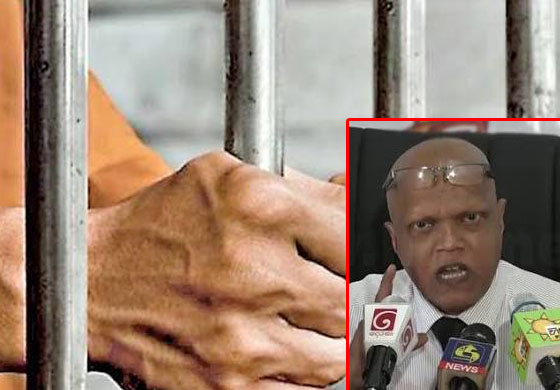
1. Introduction
In a democratic state, the rule of law is upheld only when the law is applied equally to all persons. If differences are made in the enforcement of the law based on a person’s religion, political connections, social status, economic power, or other personal characteristics, this becomes a serious issue concerning the rule of law.
The recent incidents relating to the use of handcuffs when suspects and prisoners in Sri Lanka are taken before courts have once again drawn public attention to this issue under the following circumstances, in particular:
a) The presentation of Ven. Galagoda Aththe Gnanasara Thera before court in handcuffs.
b) The bringing of Mr. Namal Rajapaksa, a former Minister and Member of Parliament, before court in handcuffs.
c) Questions that have arisen regarding the security measures followed when persons accused in connection with the Easter Sunday terrorist attacks were presented before court.
d) Video footage appearing to show persons accused in the Easter Sunday attacks case being taken onto a prison bus after court proceedings without handcuffs, while one prisoner was heard shouting, “අපිට අනුර සර් ඉන්නවා” (“We have Anura Sir”).
When these incidents are compared with one another, an important legal question arises. Is the decision to use handcuffs based on a genuine security risk posed by the individual, or on other factors not recognized by law?
2. The Law Relating to the Use of Handcuffs in Sri Lanka
The laws relating to using handcuffs and other restraints to suspects, convicted prisoners and accused persons are provided in several legal instruments such as Code of criminal Procedure Act No 15 of 1979, The Prisons Ordinance No. 16 of 1887, all amendments introduced to those principal enactments up-to-date, the regulations, rules and administrative orders issued thereunder.
2.1. Section 28 of the Code of Criminal Procedure Act
Section 28 of the Code of Criminal Procedure Act, No. 15 of 1979, concerns the restraint of an arrested person. It provides that a person arrested must not be subjected to more restraint than is necessary to prevent escape. This section establishes a general principle against unnecessary restraint.
Accordingly, the mere fact of arrest does not, by itself, establish that a suspect must be placed in handcuffs. The provision should not, however, be treated as the sole statutory source governing the restraint of prisoners already in prison custody; the Prisons Ordinance and applicable prison rules and administrative directions must also be considered.
2.2. Section 89 of the Prisons Ordinance
Section 89(1) of the Prisons Ordinance concerns the use of fetters and other mechanical restraints on prisoners outside prison. It permits restraints as a precaution where necessary to prevent violence, disorder, riotous conduct, escape, or rescue by other persons, subject to the statutory conditions and any applicable rules.
The provision is therefore security-oriented. It does not make the use of handcuffs mandatory whenever a prisoner is taken outside prison.
The precise scope of the provision should be read together with the remainder of the Ordinance, regulations, prison rules, and any lawful administrative directions in force at the relevant time. The statutory text should be checked, particularly because terminology concerning “fetters” or “mechanical restraints” may not be identical to the term “handcuffs.”
2.3. Section 88 of the Prisons Ordinance
Section 88 of the Prisons Ordinance addresses the use of irons and other mechanical restraints as punishment. It should not be paraphrased more broadly than its text without consulting the current applicable prison rules. The provision supports the proposition that mechanical restraints must not be imposed as an unlawful form of punishment. It does not, by itself, establish every proposition concerning humiliation, dignity, or the legality of a particular use of handcuffs. When the constitutional prohibition of cruel, inhuman, or degrading treatment is read together with section 89, the relevant provisions support the conclusion that restraints must have a lawful and security-related justification and must not be used merely to punish or humiliate.
3. Bringing Ven. Gnanasara Thera before Court in Handcuffs
It must be stated at the outset that the facts stated here are mainly based on news items published in the newspapers such as ‘The Sunday Times’ of 11 October 2026. Accordingly, the photographs showing Ven. Galagoda Aththe Gnanasara Thera being brought before court in handcuffs and wearing prison clothing would raise separate questions concerning the use of restraints and the application of prison clothing rules.
The issue concerning the robes relates potentially to religious freedom, Buddhist disciplinary practice, and prison clothing regulations. Those matters should be treated as legally established violations only after identifying the applicable constitutional provisions, statutory rules, prison regulations, and facts.
The issue concerning handcuffing relates principally to the applicable provisions of the Prisons Ordinance, including section 89, together with any relevant rules or administrative directions.
The important questions that must be examined are:
a) Was there a documented risk that Ven. Gnanasara Thera would escape, engage in violence, cause disorder, or be rescued?
b) If such a risk existed, how was it assessed?
c) Was a specific security assessment conducted in relation to the use of restraints?
d) Were less restrictive measures reasonably available?
e) Did the relevant officer act within the authority conferred by the Ordinance and applicable rules?
To answer these questions, the relevant reports, prison records, and orders of prison officials must be examined.
4. Bringing Mr. Namal Rajapaksa before Court in Handcuffs
In examining this incident legally, what is important is not Mr. Namal Rajapaksa’s political status. The relevant issue is the relationship between the circumstances of custody, any documented security risk, and the legal authority governing restraints. The law does not create a general exemption from the use of restraints for persons accused of financial offences. At the same time, the nature of an allegation alone does not make handcuffing mandatory.
Therefore, the question that must be examined here is what security factors formed the basis of the decision to use restraints, whether those factors were recorded, and whether the decision complied with the applicable law and prison rules.
However it must be emphasized that the facts relating to this incident too are based on the newspaper reports which require verification by independent means as well.
5. Presenting the Accused in the Easter Sunday Terrorist Attacks Case before Court
The Easter Sunday Muslim religious terrorist attacks of 21 April 2019 were among the most serious terrorist attacks in Sri Lanka’s recent history. Criminal proceedings have been instituted against numerous persons in connection with those attacks. It has been reported that special police and security arrangements were deployed on some occasions.
A video clip appearing to show persons accused in the Easter Sunday attacks case being taken onto a prison bus after court proceedings without handcuffs requires careful authentication. If the footage is authentic, accurately dated, and correctly identifies the persons shown, it may provide relevant evidence concerning the manner in which those persons were transported on that occasion. It may also raise questions about whether restraints were considered necessary and what security assessment was made.
The video alone does not establish the complete legal position. It must be verified against the date, location, and identity of the persons shown, the applicable security arrangements, and the relevant prison transport records. The statement heard in the footage should not be treated, without further evidence, as proof of political influence or preferential treatment. Its significance is that it may warrant an explanation of the circumstances in which the prisoner made the statement and the security arrangements under which the prisoners were transported.
So, the central questions are therefore:
a) Were the accused in the Easter attacks case transported after court without handcuffs on that occasion?
b) Was the same practice followed for all persons in the group?
c) What security assessment justified transporting them without handcuffs?
d) Were the same criteria applied to other prisoners, including Ven. Gnanasara Thera and Mr. Namal Rajapaksa?
e) Did any officer give a specific direction concerning the use or non-use of handcuffs?
f) Are the video footage and the prison transport records consistent with one another?
Furthermore, it would not be accurate to describe all persons accused of involvement in the Easter attacks as persons who have been convicted by a court. Until a final conviction is entered, persons charged with criminal offences are entitled to the presumption of innocence under Article 13(5) of the Constitution. Article 13(5) provides that every person shall be presumed innocent until proved guilty, subject to the qualification stated in the constitutional text.
Nevertheless, it is a legitimate public interest to examine how the security risk was assessed when persons accused in connection with a serious terrorist incident such as the Easter attacks were brought before court.
6. Legal Comparison of the Three Incidents
Table 1: below provides comparison of the incidents.
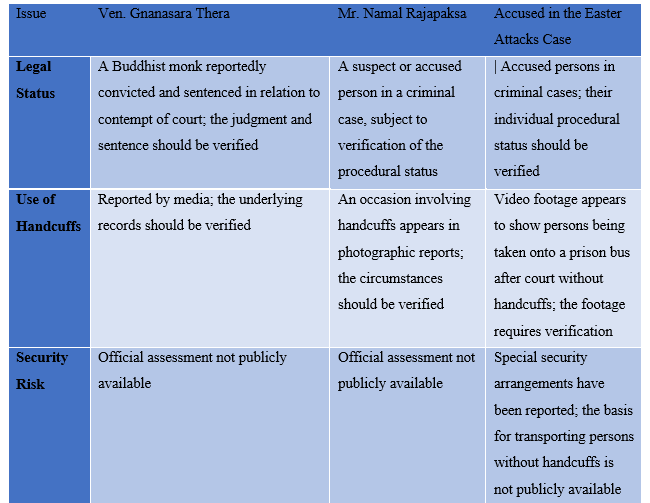
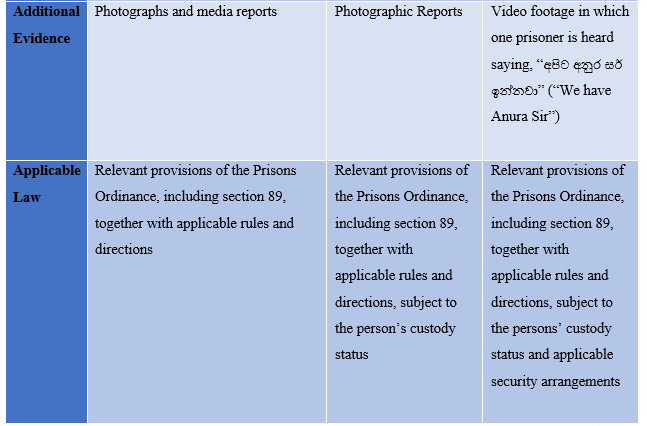
The principal question arising from this comparison is whether the Department of Prisons uses lawful, relevant, and consistently applied criteria to assess the security risk posed by prisoners.
7. The Relationship between the Seriousness of the Offence and the Use of Handcuffs
An important legal distinction must be recognized here. The seriousness of an offence and the security risk posed by a prisoner are not the same matter. For example, persons accused of mass killing motivated by extremist religious ideologies may present a high risk of escape. Conversely, a person accused of contempt of court, or financial offences may present a low risk of escape or violence. Therefore, on reasonable and objective assessment only it can be concluded that a person accused of a serious offence must necessarily be handcuffed, or that a person facing a comparatively less serious allegation must not be handcuffed.
However, factors such as the nature of the offence, a history of violence, and the possibility of escape, links with external organizations, and the risk of the prisoner being rescued may be relevant to a security assessment, provided that their use is authorized by law and applied rationally.
Examining these factors is particularly important in relation to persons facing terrorism-related allegations. The seriousness of terrorism-related allegations may be relevant to security planning, and to decide that restraints are necessary in every case.
8. Equality before the Law — Article 12(1)
Article 12(1) of the Constitution of Sri Lanka provides:
“All persons are equal before the law and are entitled to the equal protection of the law.”
This provision limits arbitrary or irrational distinctions by public authorities. It does not require identical treatment in circumstances that are materially different. The differential treatment may be constitutionally permissible where it is based on relevant differences, has a lawful basis, and is not arbitrary or discriminatory. Article 12(2) also prohibits discrimination against citizens on the listed grounds in that provision. So, it should be noted that the constitutional provisions should therefore not be presented as creating an unrestricted constitutional right to identical treatment in every administrative decision.
Applying different security measures to two prisoners is not necessarily unlawful where the difference is based on a relevant and reasonable security assessment made under lawful authority. This principle applies equally to Ven. Gnanasara Thera, Mr. Namal Rajapaksa, and the accused in the Easter attacks case.
If decisions regarding the use of handcuffs were varied on the basis of political affiliation, religious identity, or other irrelevant or constitutionally prohibited factors, that matter could raise issues under Article 12, subject to the applicable constitutional remedies, facts, and procedural requirements.
However, the existence of such differences and their legal significance must be established by evidence. Article 12(1) should not be treated as automatically creating a private cause of action against every inconsistent administrative decision.
9. Handcuffing and Personal Dignity
Article 11 of the Constitution provides that no person shall be subjected to torture or to cruel, inhuman, or degrading treatment or punishment. Handcuffing a prisoner may be a security measure authorized by law. However, if restraints are imposed or displayed for the purpose of humiliating a person, or in circumstances that reach the constitutional threshold of cruel, inhuman, or degrading treatment, their legality may be questioned. Not every improper, harsh, or embarrassing use of handcuffs will necessarily amount to a violation of Article 11. The purpose of the handcuffing, the manner in which it was carried out, and its duration, the degree of force or exposure involved, the person’s condition, and its consequences must be considered.
There is a legal distinction between handcuffing for a lawful and necessary security purpose and handcuffing for the purpose of humiliation.
10. International Human Rights Law
The United Nations Standard Minimum Rules for the Treatment of Prisoners, known as the Nelson Mandela Rules, are relevant international standards concerning the treatment of prisoners.
Rule 47
Rule 47 provides that the use of chains, irons, or other inherently degrading or painful restraints is prohibited and that other restraints may be used only where authorized by law and in specified circumstances, including as a precaution against escape during transfer, for medical reasons, or by direction of the prison director where other methods of control would fail.
Rule 48
Rule 48 requires that restraints be used only where the lesser forms of control would not be effective, and that they be imposed in the least restrictive manner necessary and removed as soon as possible after the risk has ceased.
Rule 49
Rule 49 provides that the prison administration should seek access to and promote the use of control techniques that avoid or reduce the use of restraints.
These rules are internationally recognized minimum standards. They are not, merely by virtue of their adoption by the United Nations General Assembly, directly enforceable in Sri Lanka in the same manner as an Act enacted by Parliament. Their domestic legal effect must not be overstated.
Nevertheless, they may provide persuasive guidance when assessing prison administration standards and interpreting domestic law consistently with Sri Lanka’s international human-rights commitments, subject to the Constitution, legislation, and applicable judicial doctrine.
11. Responsibility of the Department of Prisons
For a fair legal examination of these incidents, information should be obtained from the Department of Prisons on the following matters:
a) What written criteria are used when deciding to restrain prisoners being taken before court?
b) What relevant rules or regulations have been made under section 94 of the Prisons Ordinance, and what is their current legal status?
c) Which officer decides whether a prisoner should be restrained?
d) Is a written security assessment conducted for such decisions?
e) What facts formed the basis of the security measures followed in relation to Ven. Gnanasara Thera and Mr. Namal Rajapaksa?
f) What decisions were taken regarding the use of restraints when the accused in the Easter attacks case were presented before court?
g) What administrative mechanisms exist to prevent prisoners at the same level of security risk from being treated differently?
h) What is the Department of Prisons’ explanation of the video footage appearing to show the accused in the Easter attacks case being taken onto a prison bus after court without handcuffs?
i) Who authorized the relevant transport arrangements, and were those arrangements recorded in writing?
j) Has the Department investigated the statement heard in the footage, “අපිට අනුර සර් ඉන්නවා” (“We have Anura Sir”), and, if so, what was the context and outcome of that investigation?
This information may be requested under the Right to Information Act, No. 12 of 2016. However, the Act contains exemptions, including exemptions that may be relevant to national security, law enforcement, personal privacy, and other protected interests. Whether an exemption applies depends on the requested record and the statutory test. A request should therefore identify the records sought and should not assume that all security-related information is exempt or that all such information must be disclosed.
12. The Risk of Selective Enforcement of the Law
The most serious threat to the rule of law is not the power of the law itself, but the selective exercise of that power. If the power to use restraints is applied strictly to some individuals and leniently to others, there must be a lawful and relevant justification for that difference. In the absence of such justification, the decision may raise issues of arbitrary administrative action and, where the constitutional requirements are met, equality before the law.
The confirmation that Ven. Gnanasara Thera and Mr. Namal Rajapaksa were brought before court in handcuffs and as such their rights were violated depends on the answers to the questions raised in thwe subparagraph 11 above.
Similarly, even if the video footage is confirmed to show that persons accused in the Easter attacks case were taken onto a prison bus without handcuffs, it should be considered in the light of the answers that the prison authorities may provide to the questions raised in subparagraph 11 above
The decisive questions are whether lawful and reasonable security reasons existed for the relevant decisions, whether the decision-maker acted within the scope of the statutory power, and whether relevant criteria were applied consistently.
The statement heard in the footage, “අපිට අනුර සර් ඉන්නවා” (“We have Anura Sir”), may intensify public concern about possible political influence. However, that concern must be investigated through reliable evidence rather than treated as an established legal fact solely on the basis of a short video clip.
13. Conclusion
There is statutory authority under Sri Lankan law, to use certain restraints on prisoners in specified security-related circumstances. The precise authority depends on the person’s custody status, the applicable provisions of the Prisons Ordinance, relevant rules or regulations, and the facts of the case.
That authority is not an authority to punish or humiliate a prisoner.
Section 89 of the Prisons Ordinance is directed to security-related purposes, but its application must be read with the exact statutory text, applicable rules, and any relevant administrative directions. Section 28 of the Code of Criminal Procedure Act expresses a general principle against subjecting an arrested person to more restraint than is necessary to prevent escape, but it should not be treated as the complete legal code governing all restraints used on prisoners.
Article 12(1) of the Constitution provides a basis for questioning arbitrary or irrational differences in the exercise of authority by public officers. It does not require identical treatment where relevant security circumstances differ, and a constitutional claim would depend on the evidence, the decision challenged, and the applicable procedural requirements.
When the incidents involving Ven. Gnanasara Thera, Mr. Namal Rajapaksa, and the accused in the Easter attacks case are considered together, questions arise regarding the transparency and consistency of prison security procedures.
The video footage appearing to show the accused in the Easter attacks case being taken onto a prison bus after court without handcuffs, together with the statement “අපිට අනුර සර් ඉන්නවා” (“We have Anura Sir”), makes it particularly important for the authorities to explain the security arrangements and the criteria applied in that instance. An independent inquiry and examination of the relevant official records are necessary to answer these questions.
The rule of law does not mean restraining all prisoners. It means applying lawful, relevant, and consistently administered criteria equally to persons in materially similar circumstances.
If the power to use restraints becomes a power that varies according to political influence, religious identity, or social status rather than lawful security considerations, it will undermine the rule of law. Therefore, it is essential to maintain a clear, transparent, consistently applied administrative policy on the use of restraints that protects human dignity.
References
1. Code of Criminal Procedure Act, No. 15 of 1979, s 28. The exact wording and current application should be checked against the official text.
2. Prisons Ordinance (Chapter 54), including ss 88–94 and 96. The specific propositions attributed to each section should be verified against the current official consolidated text and applicable rules or regulations.
3. Constitution of the Democratic Socialist Republic of Sri Lanka (1978), arts 11, 12(1), 12(2), 13(1), and 13(5). Article 13(5) concerns the presumption of innocence; Article 13(1) concerns arrest and detention according to procedure established by law.
4. United Nations General Assembly, United Nations Standard Minimum Rules for the Treatment of Prisoners (the Nelson Mandela Rules), UNGA Res 70/175 (17 December 2015), rules 47–49.
5. The Sunday Times, ‘Uproar over monk’s robe forces govt into damage-control mode’ (11 October 2026). Publication and date require verification.
6. Onlanka, ‘Namal Rajapaksa remanded until October 6, 2026 in Krrish case’ (October 2026). Publication, date, and contents require verification.
7. The Morning, ‘MP Namal Rajapaksa taken to remand prison’ (September 2026). Publication and contents require verification.
8. Daily Mirror, ‘Easter Sunday attack suspects brought to court’ (12 January 2022). Publication and contents require verification.
9. Daily Express, ‘Eight Easter Sunday attack accused file written submissions without lawyers’ (September 2026). Publication and contents require verification.
10. News Center, ‘Special security at Aluthkade courts as long-awaited 2019 Easter Sunday attacks verdict due today’ (September 2026). Publication and contents require verification.
11. Video footage appearing to show persons accused in the Easter Sunday attacks case being taken onto a prison bus after court proceedings without handcuffs. Authenticity, date, location, identity, and chain of custody require verification.
Research limitation: Since all official orders concerning the use of handcuffs, security assessment reports, relevant prison rules, and the authenticity and full context of the video footage have not been independently verified, this article does not reach a final conclusion that any particular official violated the law.
Assoc. Prof. Raja Goonaratne,
Department of Legal Studies
The Open university of Sri Lanka
සම්බන්ධිත පුවත් | Related News







ප්රධාන පුවත්
PTA අහෝසි කරනවා කිව්ව අය PSTA ගෙනැවිත් වෘත්තීය සමිති අහෝසි කරන්න හදනවා.. වසර දෙකක් නඩු නැතුව හිරේ තියන්න හමුදාවට බලය දෙන PSTA පනත වහා හකුළා ගනු! - ජාතික ගුරු ව්යාපාරය ආණ්ඩුවට රතු එළියක්
අනුරාධපුර පූජා නගරයේ ආත්මය මරා දමන්න හදන නූතන එළාර ලා..
1818 කැරැල්ල ගැන කියමින් අගමැතිතුමිය ඉතිහාසය විකෘති කරන්නේ කුමන පදනමකින්ද? - ජාතික ගුරු ව්යාපාරය ප්රශ්න කරයි..
ඇමරිකා බාධක නිසා දකුණු මුහුදේ හිරවුනු ඉරාන නැවුවල නැවියන් පිරිසක් ගාළු වරායට ගෙනේ..
චීන-ශ්රී ලංකා රබර්-සහල් ගිවිසුමට මුල් වූ ආර්.ජී. සේනානායක මහතාගේ පවුලේ සාමාජිකයින් චීන තානාපතිවරයා හමුවෙයි..
විජේවීර හිරෙන් නිදහස් වුණේ ජේ.ආර්. ජනාධිපති සමාවක් දීලාද?.. සම්පූර්ණ සත්ය කතාව මෙන්න..
දොස්තරලා දැඩි වෘත්තීය ක්රියාමාර්ගයක.. රට පුරා විරෝධතා කැඳවයි..
රුපියල් බිලියන 7.7ක අනුරාධපුර පූජා භූමි සංවර්ධන ව්යාපෘතියේ ප්රගතිය සොයන්න ජනපති අනුරාධපුරයට යයි..
රාජ්ය ආයතන 34ක් මුළුමනින්ම වසා දානවා.. - ජනපති
ඥානසාර හිමියන්ගේ සිවුර ඉවත් කිරීමට එරෙහි රිට් පෙත්සම් විභාගය නොවැම්බර් 18 දාට..
කලාපයේ වැඩිම ගෘහස්ථ විදුලි ගාස්තුව ලංකාවේ.. - SenFin
ඥාණසාර හිමි වෙනුවෙන් සත්යග්රහයට අධිකරණ නියෝගයක්.. ඉවත් කරන්න පොලිසිය පැමිණීමෙන් උණුසුම් තත්වයක්..
පනාමුරේ තිලකවංශ නාහිමියන්ට ජීවිත ආරක්ෂාව ඉල්ලමින් මහජන ආරක්ෂක නියෝජ්ය අමාත්යවරයාට ලිපියක්..
ඉරාන තෙල් නැව්වලට සහන දීම ගැන ශ්රී ලංකාව අර්බුදයක.. අවසන් තීරණයක් ගෙන නැති බව TIMES OF INDIA වාර්තා කරයි..
නව ත්රස්ත පනතෙන් මානව හිමිකම් දැඩි ලෙස උල්ලංඝනය වීමේ අවදානමක්.. - ඇම්නෙස්ටි ඉන්ටර්නැෂනල්
පොලිස්පතිවරයා අධිකරණයට අපහාස කළ බව ප්රකාශ කරමින් ගම්පහ මහේස්ත්රාත්වරයා අදාළ ලිපිගොනු අභියාචනාධිකරණයට ඉදිරිපත් කරයි..