A World Healed Cuba's Medical Internationalism, Under Threat!

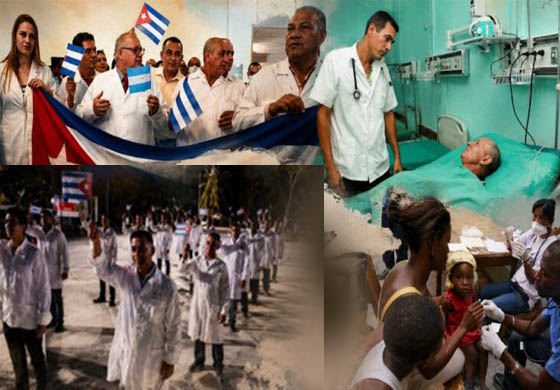 The United States of America refers to Cuba's medical internationalism as "human trafficking." But it is truly a lifeline of internationalism for the Global South. This article is about that.
For decades, tens of thousands of Cuban medical professionals have been stationed in about sixty countries around the world. That is far more than the World Health Organization's (WHO) workforce. Mostly, they serve in the Global South, in populations with limited or no medical services. By threatening to suspend visas to foreign officials, the U.S. government aims to disrupt these Cuban medical missions abroad. If implemented, millions of people worldwide would suffer even more.
The United States is currently waging an economic war against revolutionary Cuba, following a strategic agenda of "hunger, despair, and regime change."
Here, the U.S. government accuses Cuba of human trafficking, likening foreign Cuban medical personnel to slaves. The real objective here is to undermine both Cuba's international prestige and the income generated from medical service exports. Since 2004, revenue from Cuban medical and professional service exports has become Cuba's largest source of income. The prolonged U.S. blockade currently impedes Cuba's ability to conduct "normal" international trade. However, the Cuban socialist state has managed to convert its investment in education and healthcare into national earnings—while maintaining free medical aid to the Global South based on internationalist principles.
Cuban Medical Internationalism: A Fundamental Feature of Cuban Foreign Policy
The four prongs of Cuban medical internationalism were initiated in the early 1960s—despite the fact that half of the doctors then in Cuba left after 1959. These four prongs are:
Emergency Response Medical Brigades – In May 1960, the state of Chile suffered one of the most powerful earthquakes on record, killing thousands. The new Cuban government sent an emergency medical brigade with six rural hospitals. This established a rapid response mobilization procedure for Cuban doctors for "disaster and disease" emergencies throughout the Global South. Since 2005, these brigades have been organized under the name "Henry Reeve International Contingents." By 2017, when the WHO awarded the Henry Reeve Contingents a 'Public Health Prize,' they had assisted 3.5 million people in twenty-one countries. Notable examples include the contingents deployed to West Africa for Ebola containment in 2014 and the medical brigades responding to the COVID-19 pandemic in 2020. Within a year, the Henry Reeve Contingents had treated 1.26 million coronavirus patients in forty countries, including Western Europe.
Establishing Public Health Services Abroad – From 1963 onwards, Cuban doctors helped establish a public health system in newly independent Algeria. By the 1970s, they had set up and staffed comprehensive health programs across Africa. By 2014, 76,000 Cuban medical personnel had served in thirty-nine African countries. In 1998, a Cuban cooperation agreement with Haiti committed to sending between 300 and 500 Cuban medical professionals there while training Haitian doctors in Cuba. By December 2021, over 6,000 Cuban medical professionals had saved 429,000 lives and conducted 36 million consultations in the poorest country in the Western Hemisphere. For two decades, Cuba has maintained over 20,000 doctors in Venezuela, a number that has risen to 29,000. In 2013, the Pan American Health Organization contracted 11,400 Cuban doctors to work in underserved areas of Brazil. By 2015, Cuban integrated health programs were operating in forty-three countries.
Treating Foreign Patients in Cuba – In 1961, children and wounded combatants from Algeria's struggle for independence from France went to Cuba for treatment. This was followed by thousands from around the world. Two programs were developed for mass treatment of foreign patients: the first was the "Children of Chernobyl" program, which began in 1990 and lasted twenty-one years. During that time, 26,000 people affected by the Chernobyl nuclear disaster received free medical treatment and rehabilitation services in Cuba—nearly 22,000 of them children. This program continued despite the severe economic crisis in Cuba known as the Special Period, which followed the collapse of the socialist camp; the Cubans bore the cost. The second mass treatment program was Operation Miracle, established in 2004, enabling Venezuelans to receive free eye surgery in Cuba to restore their sight. It later expanded regionally. By 2017, Cuba maintained sixty-nine eye clinics in fifteen countries under Operation Miracle. By early 2019, over four million people from thirty-four countries had benefited.
Medical Training for Foreigners in Cuba and Abroad – It is extremely important to note that the Cuban state has never sought to foster dependence on its doctors by other countries. In the 1960s, it began training foreigners in their own countries when facilities were suitable, or in Cuba when they were not. By 2016, 73,848 foreign students from eighty-five countries had graduated in Cuba. Additionally, Cuba maintained twelve medical schools abroad, mostly in Africa, with over 54,000 students enrolled. In 1999, the Latin American School of Medicine (ELAM), the world's largest medical school, was established in Havana. By 2019, ELAM had graduated 29,000 doctors from 105 countries (including the United States), representing 100 ethnic groups. Half were women. Seventy-five percent of the total came from working-class or poor families.
The Financial Cost of Cuba's Contribution
Since 1960, approximately 600,000 Cuban medical professionals have provided free health services in over 180 countries. The Cuban government has borne most of the cost of its medical internationalism, representing a massive contribution to the Global South—especially considering the impact of the U.S. blockade and Cuba's own development challenges. "Some may wonder how a small country with few resources can accomplish so much in critical areas like education and health," Fidel Castro remarked in 2008. However, he did not provide the answer. In fact, Cuba has said little about the cost of these programs.
Nevertheless, researcher Henry Morales from Guatemala has framed Cuba's international cooperation as "Official Development Assistance" (ODA). Using average international market rates and following the methodology of the Organisation for Economic Co-operation and Development (OECD), this facilitates calculating the scale of their contribution to global development and comparing it with other donors. According to Morales, the financial value of Cuba's medical and technical professional services between 1999 and 2015 exceeded $71.5 billion, equivalent to an annual average of $4.87 billion. This means Cuba devoted an average of 6.6% of its GDP annually to ODA—the highest rate in the world. In comparison, the European average was 0.39% of GDP, while the U.S. contribution was only 0.17%. During this period, the U.S. blockade cost Cuba between $4 and $5 billion annually. Without that burden, Cuba could potentially have doubled its ODA contribution.
These expenditures exclude Cuba's state investment in education, medical training, and infrastructure. Cuba also incurs significant losses by charging below international market rates or, in many cases, charging nothing at all.
Medical Services as an Export
During the "Special Period" of the 1990s, Cuba introduced reciprocal agreements to share costs with recipient countries. From 2004 onwards, with the famous "doctors for oil" program with Venezuela, exporting medical professionals became Cuba's primary source of revenue. This income was subsequently reinvested in Cuban medical supplies. However, Cuba continues to provide free medical aid to countries in need. Today, there is a spectrum of cooperation agreements, ranging from Cuba covering all costs (donations and free technical services), to cost-sharing agreements (with the host country), "triangular cooperation" (third-party partnerships), and commercial agreements. All of these will be affected by the new blockade measures announced by the United States.
In 2017, Cuban doctors operated in 62 countries. In 27 of these, the host government paid nothing, while the remaining 35 countries paid or shared costs to some degree. When the host government covers all costs, it does so at rates lower than those charged internationally. Different payments are used to balance Cuba's accounts. Thus, services charged to wealthy oil states (e.g., Qatar) help subsidize medical aid to poorer countries. Payment for medical service exports goes to the Cuban government, which gives a small portion to the doctors themselves, generally on top of their Cuban salaries.
In 2018, the first year Cuba's National Statistics Office published separate data, "health service exports" earned $6.4 billion. However, revenues have fallen since then. U.S. efforts to disrupt Cuban medical internationalism have been successful. For example, the case of Brazil contributed to reducing Cuba's income by billions.
The U.S. Criminalization of Cuban Medical Internationalism
In 2006, the George W. Bush administration launched a program to entice Cuban doctors to abandon their missions in exchange for U.S. citizenship. President Barack Obama maintained this program until his final day in office in January 2017. In 2019, President Donald Trump renewed the attack, adding Cuba to the list of countries failing to combat "human trafficking" based on its medical internationalism. USAID even launched a project to discredit and disrupt Cuban health programs. In 2024, a draft bill from the U.S. House Committee on Discharge included provisions to "expose trafficking of doctors from Cuba," withdraw aid from "countries that participate in this modern-day slavery," and prohibit funding for Cuban laboratories.
The service contracts that Cuban doctors sign before going abroad are in fact voluntary. They receive their regular Cuban salary plus compensation from the host country. Volunteers are guaranteed holidays and contact with their families. Whatever their motivation for participating, Cuban medical professionals abroad make significant personal sacrifices. They leave families, homes, their culture, and communities to work for months or years under challenging and often hazardous conditions. Dr. Jesus Ruiz Aleman, interviewed in the documentary "Cuba and COVID-19: Public Health, Science and Cooperation," explains how a sense of moral duty compelled him to volunteer for the Henry Reeve Contingents. He went to Guatemala in 2005, West Africa for Ebola in 2014, and to Italy, the epicenter of the COVID-19 pandemic, in 2020. "I never felt like a slave," he emphasizes. He suggests the campaign against the medical brigades appears to be a way to justify the blockade against Cuba and damage a source of Cuban revenue.
The Threat of a Good Example
The dominant global approach promoted by the United States treats healthcare as an expensive commodity or trade good to be rationed through market mechanisms. Medical students "invest" in their education by paying high tuition fees and graduating with large debts. They then seek high-paying jobs to repay those debts and pursue a privileged lifestyle. To ensure doctors are well-paid, demand must be kept higher than supply. The World Economic Forum projects a global shortage of 10 million health workers by 2030. However, Cuba's investment in medical education increases the global supply of medical professionals, threatening the status of doctors operating under a market system. Crucially, the Cuban approach removes financial, class, race, gender, religious, and any other barriers to entering the medical profession.
Key features of the Cuban approach include its commitment to healthcare as a human right, the critical role of state planning and investment in providing a universal public health system with no parallel private sector, an accelerated pace in delivering healthcare (by the 1970s, Cuba already had the health profile of a highly developed country), a focus on prevention rather than cure, and a community-based primary care system. Through these methods, socialist Cuba has achieved health outcomes comparable to developed countries but at much lower per capita costs—less than one-tenth of U.S. per capita spending and less than a quarter of the UK's. By 2005, Cuba had achieved the world's highest rate of doctors per capita. By 2018, it had three times the density of doctors compared to the U.S. and UK.
Today, Cuba is in the midst of a severe economic crisis, largely caused by U.S. sanctions. Following a massive migration wave since 2021, the public health system faces unprecedented pressure with resource and personnel shortages. However, the government continues to dedicate a high percentage of GDP to healthcare (nearly 14% in 2023), maintains free universal medical coverage, and currently has 24,180 medical professionals in 56 countries.
Revolutionary Cuba has never been concerned solely with meeting its own needs. Between 1999 and 2015 alone, foreign-based Cuban medical professionals saved an estimated 6 million lives, performed 1.39 billion medical consultations and 10 million surgeries, and attended 2.67 million births. 73,848 foreign students graduated as professionals in Cuba, most of them doctors.
The nations benefiting from Cuban medical internationalism are often among the poorest and least influential globally; only a few have governments with some power on the world political stage. Within those countries, the beneficiaries are often the most disadvantaged and marginalized populations. If Cuban doctors were to leave these countries, they would have no alternative. If the U.S. succeeds, it will not only be Cubans who suffer. It will also be the millions of global beneficiaries whose lives are currently being saved and improved by Cuban medical internationalism.
- Aruna Ovitigala
සම්බන්ධිත පුවත් | Related News
ප්රධාන පුවත්
උතුරු කොරියාව සහ රුසියාව යාකරමින් කිලෝමීටරයක් දිග පාලමක්..
ආණ්ඩුවේ නායකයින් ගනුදෙනුකරුවන් සතුටු කිරීම සඳහා ඕනෑම දෙයක් කරන අසරණ වෛශ්යාවන් ලෙස කටයුතු කරනවා.. - ජාතික සංවිධානවලින් චෝදනා..
ලොවක් සුවපත් කරන කියුබාවේ වෛද්ය ජාත්යන්තරවාදය, අනතුරේ!
කළුතර ප්රා. සභාවේ පන්සිල්, ජාතික ගීය සහ රණවිරු සැමරුම් තහනම්.. - නියෝගය කොමසාරිස්ගෙන්..
එක්සත් ජාතීන්ගේ මානව හිමිකම් මණ්ඩලයේ 63 වන සැසිය ඇරඹේ.. - මෙරට ගැන වාර්තාවක් අද..
දූෂිත නිමල් පෙරේරා ආණ්ඩුවේ ප්රබල අමාත්යවරයකුගෙ ව්යාපාරික සගයෙක්.. - ඩී.වී චානක
22 සංශෝධන පෙත්සම් විභාගය ගැටළුකාරීයි.. - අධිකරණ ස්වාධීනත්වය ගැන පොදුරාජ්ය මණ්ඩලීය නීතිඥ සංගමය ප්රශ්න කරයි..
22ට එරෙහි පෙත්සමක් විභාගයට නොගැනීමෙන් මූලික අයිතිවාසිකම් කඩ වූ බවට ශ්රේෂ්ඨාධිකරණයට පෙත්සමක්..
සරණාගත ජාවාරම පවත්වාගෙන යාම සඳහා එල්ටීටීඊ හිතවාදී ඩයස්පෝරාව ‘දෙමළ ජනතාවට ශ්රී ලංකාව ආරක්ෂිත නැත’ යන්න ප්රචාරය කරයි..
ආණ්ඩුවට වසර දෙකයි.. ඩඩ්ලිට ධම්මිකට ඉෂාරට සුබයි.. ජනතාවටයි, ගමේ ජෙප්පන්ටයි දුකේ දුකයි.. - ආණ්ඩුවේ දෙවසරක අස්වැන්න ගැන විමල් වීරවංශගේ හෙලිදරව්වක්..
සෞඛ්ය සේවයට ජනපතිගෙන් අලුත් වෙනසක් - “හිතුන හිතුන වෙලාවට ඉස්පිරිතාලේට යන්න බෑ...කොත්තමල්ලි ටිකක් බීලා විවේකීව ගෙදරට වෙලා ඉන්න”
22 අනිවාර්යයෙන්ම සම්මත කරනවා.. - ජනපති කියයි
ඉන්දීය ආරක්ෂක ඇමති අනිද්දා දිවයිනට..
හෙල්ල විසිකිරීමේ ඩයමන්ඩ් ලීග් කිරුළ රුමේෂ් තරංගට..
අමෙරිකා ප්රහාරවලට ප්රතිචාර ලෙස ඉරානයෙන් හෝමුස් වෙත මිසයිල ප්රහාර..
22 මුල්කරගෙන හරිනි කැරැළි ගසන්නේ නැහැ.. අධිරාජ්යවාදී බලවේග ඊට සහාය දෙන්නේ නැහැ.. - ජාතික සංවිධානවලින් සහතිකයක්..