
Ukraine’s Battlefield Crisis, Russia’s Advancing Position and the West’s Dilemma

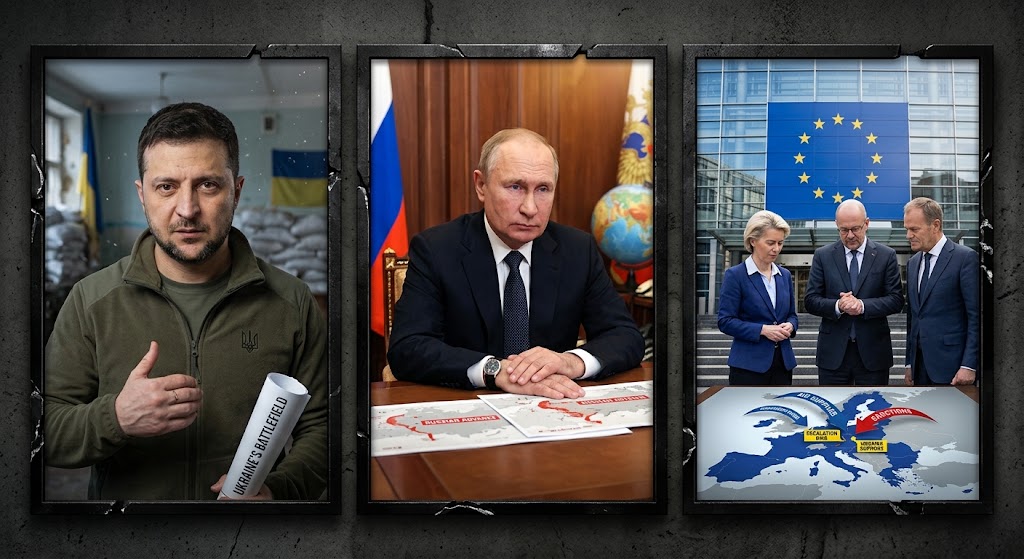 The Russia-Ukraine conflict is passing through another decisive phase. During this transitional period, intense debate is taking place around the world concerning the situation on the battlefield, Ukraine’s economic collapse, the military capabilities of Western countries, and the ultimate course of the war. Accordingly, we believe that it is necessary, for LankaLeader readers, to present a strategic assessment of the Russia-Ukraine war and a rigorous and controversial analysis of the current situation. We emphasise at the outset that the issues emerging from our study challenge the main narratives presented by Western thinkers and paint a bleak picture of Ukraine’s future prospects.
Ukraine’s Deep Strikes and Russia’s Retaliation
In recent times, Ukraine has launched increasingly ambitious deep strikes into Russian territory. At first glance, it became apparent to people around the world that these attacks were receiving extensive NATO support. They were not limited to military or energy infrastructure such as oil refineries, but also targeted civilian economic centres, such as warehouses belonging to Wildberries, Russia’s largest e-commerce company.
The strategic rationale behind these attacks is to damage the Russian economy by striking civilian economic targets, make ordinary Russian people feel the direct consequences of the war, and thereby increase internal pressure on the Kremlin to reconsider its military operation.
We acknowledge that Ukrainian attacks are indeed creating problems for Russia and could increase public dissatisfaction. However, two fundamental questions arise from the situation created by these attacks. What will the Russian government do in response to the attacks? And what impact will Ukraine’s long-range drone campaign ultimately have on the outcome of the war?
According to our assessment, the main outcome has been a more aggressive Russian military response. Particularly significant has been the renewed closure of the Odesa port complex and other Ukrainian ports on the Black Sea. As a result of this measure, Ukraine has lost active access to the Black Sea and has been forced to face devastating economic consequences that could be greater than any advantages gained from the drone attacks.
Odesa and Ukraine’s Economic Vulnerability
Odesa is an extremely important economic centre for the Ukrainian economy. It is a historical fact that approximately 90 percent of Ukraine’s agricultural goods and around 70 percent of its total exports are transported through Odesa.
From the beginning of the war launched by Russia in Ukraine against Western coalitions on February 24, 2022, until July of that year, Russia closed Odesa and the Black Sea region. The disruption during that period caused enormous damage to the Ukrainian economy. The situation changed somewhat when the ports were reopened in July 2022 through an agreement brokered under the auspices of the United Nations and Türkiye. Economic experts believe that this development was extremely beneficial to Ukraine.
Now that Russia has again closed the Odesa port complex and other Ukrainian Black Sea ports, devastating consequences for the Ukrainian economy, which has already suffered enormous damage from the war, cannot be avoided. Although Ukraine’s long-range drone strikes have caused pain and problems for Russia, it has now become clear that Moscow is capable of inflicting significantly greater damage on Ukraine in response. It has been argued that this escalation will not improve Ukraine’s situation and could instead benefit Russia.
Infrastructure Under Increasing Pressure
It now appears that the consequences are spreading far beyond the Black Sea ports. It has become increasingly evident that Russian air operations against Ukrainian infrastructure, including facilities involved in the production of drones and military equipment, have intensified.
Local media have also reported that attacks on fuel stations across eastern Ukraine have caused severe fuel shortages, making both military and civilian transportation increasingly difficult. Railway lines and locomotives have also become targets for Russia.
Accordingly, the intensification of Russian air operations directly linked to Ukraine’s attacks on Russian territory is accelerating the deterioration of Ukraine’s military and economic situation, bringing the Kyiv government even closer to the point of collapse.
From the Black Sea to Donbas
However, while Western media have been widely celebrating Ukrainian attacks on Russian vessels, their consequences are beginning to become more severe for Ukraine itself, particularly as Ukraine is gradually losing its access to the Black Sea. Even before Russia intensified its operation against Odesa, Ukraine’s economic situation had already reached an extremely difficult stage. Military analysts predict that while continued airstrikes will cause further damage to the Ukrainian economy and infrastructure, Russia will gradually strengthen its position on the battlefield.
According to them, Russia may gain control of the Donbas region by the end of 2026. Although it is still impossible to predict with certainty how much additional territory Moscow will ultimately seize, the important question is how much more territory Russia will capture. It is nevertheless likely that the amount of territory Ukraine loses will be significant.
Because control of the Black Sea ports could further weaken Ukraine economically, Odesa will inevitably become a Russian target. However, it remains doubtful whether Russia is in a position to achieve a decisive victory by capturing the entirety of Ukraine.
Military analysts argue that advancing into western Ukraine would not be a wise move for Russia because the population there is predominantly Ukrainian and would likely offer strong resistance. Instead, military analysts have expressed the view that there is a possibility of the emergence of a small, economically weak and dysfunctional Ukrainian state — a “Rump Ukraine.”
Accordingly, from the Russian perspective, military analysts believe that it would be more appropriate to capture a significant amount of Ukrainian territory while avoiding becoming bogged down for a prolonged period in areas heavily populated by ethnic Ukrainians. Under such circumstances, depriving the remaining Ukrainian state of its Black Sea ports would be an important strategic step.
They predict that Russia may achieve an “ugly victory” rather than a victory in the conventional sense. In other words, rather than ending the war by capturing all of Ukraine, the conflict could ultimately enter a “frozen” state.
Analysts also point to Ukraine’s serious shortage of manpower. Ukrainian media themselves have paid considerable attention to problems related to avoiding forced mobilisation and soldiers abandoning the battlefield. As a result, Ukraine has been forced to confront a situation in which there is insufficient manpower along the front lines.
It is also becoming increasingly clear that Ukraine’s internal decision-making process is facing serious difficulties. There has been intense international discussion over President Zelensky’s removal of the defense minister and the military chief, and replacing these two individuals responsible for making important national security decisions has created further uncertainty at a decisive moment in the war.
Taken together, the weakening of the Ukrainian front, the intensification of Russian bombardment and the political problems in Kyiv clearly demonstrate that Ukraine is “indeed in a very serious crisis.”
Ukraine Has “Changed the Course of the War”: An Assessment of the Western Narrative
Let us turn our attention to the claim described as a major Western media narrative that Ukraine has “changed the course of the war.” This narrative appears to have had some influence on President Trump. It is our belief that Trump assumed Ukraine had reached a decisive turning point and subsequently signalled that he would provide greater American support to Zelensky. However, opponents of this idea point out that the momentum behind promoting the “changing the course” narrative is already slowing or collapsing. The Western narrative surrounding the “change in the course of the war” was toned down after Russian President Vladimir Putin recently appeared confident and stated that Russia was advancing more rapidly. Nevertheless, analysts are not rushing to say precisely how or when the war will end. The reason is that the importance of drones on the battlefield is rapidly increasing.
Drones: The Weapon Helping Ukraine Remain in the War
Many believe that if drones had not been used on such a massive scale, Ukraine would have lost the war and the conflict would have ended much earlier. Our observation is that the enormous number of drones deployed along the front has forced Russian forces to advance slowly and very cautiously. At the same time, drones have helped compensate to some extent for Ukraine’s significant shortage of military manpower and its inability to deploy sufficient soldiers in forward defensive positions.
Accordingly, our conclusion is that without drones, Ukraine’s situation would inevitably have become far more dangerous. Analysts also acknowledge that, despite being numerically inferior, Ukraine has performed relatively well in using drones to slow the Russian advance. However, our assessment is that Russia is advancing and that, although the presence of drones has forced Russia to advance at a slower pace than it otherwise would have, Ukraine’s position on the front lines is ultimately unsustainable.
What Can Trump Actually Do?
Many international media outlets reported that Trump was impressed by Ukraine’s actions at the G7 meeting held in France last June and at the NATO meeting held in Ankara, Türkiye, in early July. Reviewing international media reports, it also appears that Trump had accepted the narrative that Ukraine had pushed Russia into a defensive position. However, the question was how much practical difference such a political shift could actually make. Would Trump provide Ukraine with more weapons? Would he provide more Patriot missiles? Would the United States provide tens of millions of additional dollars? These were the questions that arose before us.
The assessment was fundamentally negative. The United States will continue providing intelligence support to Ukraine, as it is already doing. However, a serious question arises as to whether Trump possesses the military resources necessary to fundamentally change the course of the war.
A similar question exists regarding what European governments can realistically do. Europe is already providing drones and intelligence, encouraging Ukraine, and supporting a planned propaganda campaign designed to strengthen Ukraine’s position. However, it is now clear that this campaign has ultimately produced the opposite result.
It has already become clear that there is no “magic formula” for the United States and the broader Western camp, whether in relation to Iran or in attempting to deliver victory to Ukraine.
The Limits of American Military Power
Some analysts assume that people in Europe view American involvement as a situation in which Washington possesses unlimited military capabilities but is hesitant over whether it has the political will to defeat Russia. However, the experience of the Biden administration demonstrated that political intent alone is insufficient and that actual military capabilities have become a major problem. There has been discussion around the world regarding American efforts to license Ukraine to develop its own Patriot missile systems. However, our observation is that America’s ability to accomplish this, even in the near or medium to long term, remains very limited.
Ukraine and the War Involving Iran
Another major topic being discussed globally is whether the Ukraine conflict could become directly connected to the war involving Iran. As soon as the issue of Ukraine’s attack on an Iranian vessel in the Black Sea and the possibility of an Iranian retaliation emerged, Ukraine appeared willing to avoid escalating the incident, with the Kyiv government stating that the attack was not deliberate.
There is very little possibility that these two wars will become directly connected in terms of actual combat. However, an important indirect connection between the two wars can be identified. That is, the ability to make American military resources being used in the Middle East available to Ukraine is at a very low level.
Patriot missiles are particularly important in this regard. Comparing the current situation with the stocks held by the U.S. military before the Iran war began on February 28, 2026, approximately two-thirds of America’s Patriot stocks have already been used. Since it takes considerable time to produce Patriot systems and missiles, the United States does not have enough Patriot systems to provide the quantities required by the Ukrainian forces.
Why Are Iran and Ukraine Unlikely to Enter a Wider War?
Military analysts say that Ukraine’s attack on an Iranian vessel is unlikely to turn the two conflicts into one larger war. According to them, Ukraine has no strategic interest in starting a war with Iran while it is already struggling for survival against Russia. Similarly, Iran has no reason to open another front against Ukraine while it is dealing with the United States and Israel.
Iran can rely on allied forces, including Hezbollah, the Houthis and Iraqi militias, to conduct a large part of the fighting against the United States and its Middle Eastern allies. Therefore, it is logical that Iran has little interest in entering another conflict with Ukraine. Accordingly, Ukraine’s attack on the Iranian vessel is unlikely to lead to a serious escalation.
The Donbas Question
As Russian forces advance from the south and west, the remaining Ukrainian defensive positions around Sloviansk and Kramatorsk may become increasingly vulnerable. However, there is a possibility of a Russian advance and encirclement after the capture of Kostyantynivka. At the same time, battlefield observations indicate that Ukrainian counterattacks have been successful in slowing the Russian advance from the north.
But what would meaningful military escalation actually look like? Many military analysts emphasise that NATO is unlikely to enter the war directly and that the West does not possess the necessary military capabilities.
Military analysts who critically question the military capabilities of European states particularly argue that whether the British and German militaries could defeat Russia in a direct confrontation remains a serious question.
The more important question is Russia’s nuclear weapons capability. Military analysts emphasise that it is highly unlikely that the West would be willing to enter a war that could potentially push Russia toward using nuclear weapons. Accordingly, we are led to conclude that the West has no realistic military option for meaningful military escalation.
However, the diplomatic route would also present the West with its own political problem. If Russia pushes the Ukrainian military back, captures a significant amount of additional territory, and then the West begins negotiations for a ceasefire or a frozen conflict similar to the situation that emerged in Korea in 1953, such an agreement would amount to an official acknowledgement that the West and Ukraine had been defeated.
Accordingly, this conflict would increasingly have to be viewed not simply as “Ukraine versus Russia,” but as “Ukraine and the West versus Russia.”
Therefore, our assessment is that if the Ukrainian military collapses or Russia begins advancing at a significantly faster pace than it has so far, neither Ukraine nor the West will be left with a good set of options.
A War Increasingly Shaped by Attrition
Ultimately, the Ukraine conflict presents a contest in which military manpower, industrial production capacity, air power, drones, the resilience of economies and access to weapons may be equally or even more important than individual battlefield operations.
Accordingly, our direct conclusion is that although Ukraine’s long-range drone attacks can inflict damage on Russia, there is a risk that they will provoke responses that impose an even greater cost on Ukraine.
The closure of Black Sea ports, pressure on infrastructure, fuel and transportation networks, combined with Ukraine’s manpower problems, will inevitably further weaken Kyiv’s position.
At the same time, the extensive use of drones has slowed the Russian advance and enabled Ukraine to continue resisting despite its disadvantage in manpower.
Therefore, the picture emerging here is not one in which Russia decisively captures the entirety of Ukraine in the immediate future, but rather one in which a gradually increasing Russian military advantage, growing economic and military pressure on Ukraine, and ultimately a frozen conflict involving a smaller and economically weaker Ukrainian state could emerge as a possible outcome.
Likewise, when considering the increasingly difficult choices facing the United States and Europe, it appears that they have reached a crossroads: continuing to support Ukraine despite limited military resources; escalating with the risk of direct confrontation with a nuclear-armed Russia; or entering negotiations that could be interpreted as an acceptance of military defeat.
Footnote: This article was prepared based on a video interview recorded with Professor John Mearsheimer on July 30, 2026.
Edited by Jeevantha Jayatiss
සම්බන්ධිත පුවත් | Related News




ප්රධාන පුවත්
ශ්රී ලංකාව NATO සංවිධානය සමඟ සබඳතා පැවැත්වීමෙන් වහල් රාජ්යයක් බවට පත්වීමේ අවදානමක්.. – ජ්යෙෂ්ඨ මාධ්යවේදී මොහාන් සමරනායකගෙන් අනාවරණයක්
උතුරු-නැගෙනහිර බෙදුම්වාදී ක්රියා වහා පාලනය කිරීමට මැදිහත්වන්න.. - ජාතික නිදහස් පෙරමුණෙන් ජනපති අනුරට ලිපියක්
වහබ්වාදී ආගමික අන්තවාදය ශ්රී ලංකා භූමියෙන් මුලිනුපුටා දැමීම සඳහා වූ ගෝඨාභය රාජපක්ෂ යෝජනාවලිය යනු කුමක් ද?
''භික්ෂුවගේ සිවුර ඉවත් කිරීම සංඝ සභාවේ තීරණයක් විය යුතුයි'' - කෝට්ටේ සංඝ සභාවෙන් බන්ධනාගාර කොමසාරිස්ට ලිපියක්
සරම්ප වසංගතය දරුණු වෙයි: නිව්යෝර්ක් හදිසි ආපදා තත්ත්වයක් ප්රකාශ කරයි! ඇමරිකාවේ සරම්ප රෝගීන් 3,887ක් – පෙන්සිල්වේනියා මරණ වාර්තා සම්බන්ධයෙන් සෞඛ්ය ලේකම් රොබට් එෆ්. කෙනඩි ජූනියර් ප්රශ්න කරයි
දේශප්රේමී සළුවලින් සැඟවුණු “ඩෙල්සි මාදිලියේ පාවාදීමකට” අනුරගේ ආණුඩුව සූදානමින්.. - විමල්ගෙන් විශේෂ හෙළිදරව්වක්..
ගලගොඩඅත්තේ ඥානසාර හිමියන් වෙනුවෙන් සිහි බුද්ධිය ඇති සිංහල, දෙමළ, මුස්ලිම් සෑම ශ්රී ලාංකිකයෙකුම කඳුළක් සැලිය යුතුයි.. - ජාතික සංවිධාන කියයි
බ්රැම්ප්ටන් නගරාධිපති පැට්රික් බ්රවුන්ගේ ප්රකාශයක් නිසා කැනඩාවේ සහ ශ්රී ලංකාවේ නැවතත් ජාතිවාදී නොසන්සුන්තාවයක් මතු වීමේ අවදානමක්..
රුසියාවෙන් නේටෝවට ප්රබල අනතුරු ඇඟවීමක්.. ස්වෛරීභාවයට තර්ජනයක් වුවහොත් න්යෂ්ටික අවි භාවිතයට සූදානම්.. - ආචාර්ය ජගත් චන්ද්රවංශගෙන් අනාවරණයක්
යේමන හමුදා ආරම්භ කළ දැවැන්ත මෙහෙයුම හමුවේ වුවද නව ප්රදේශ අත්පත් කරගත්තා- හූති කැරලිකරුවෝ අවධාරණය කරති
"ජෙප්පෝ හිඟන්නන්ට පවුඩර් දානවා.. - මෙට්රෝ බස් පෙන්නලා අපිව චූන් කරනවා" - විමල් වීරවංශ
ජනපති සමාව අහිමි වූ ගලගොඩඅත්තේ ඥානසාර හිමි යළිත් සිපිරි ගෙට.. - වසර හයේ සිර දඬුවමේ ඉතිරි කාලය ක්රියාත්මක කරන්නැයි නියෝග..
ලෝක වෙළෙඳපොළට අනුව ඉන්ධන මිල වෙනස් කරන්නැයි IMF ශ්රී ලංකාවට කියයි..
මේ හදන්නේ පන්සලට ඇති බලය ඉවත් කරන්න.. රට ඇතුළේ වෙන දේවල් ගැන හුඟක් අය දන්නේ නෑ.. - නීතිඥ සංජීව වීරවික්රමගෙන් විශේෂ අනාවරණයක්
මහින්දට කිලෝමීටර් 120ක් හදන්න රු. බිලියන 115යි.. අනුරට කිලෝමීටර් 19ක් හදන්න බිලියන 112යි.. - මහින්ද පතිරණ හෙළිකරන කතාව